

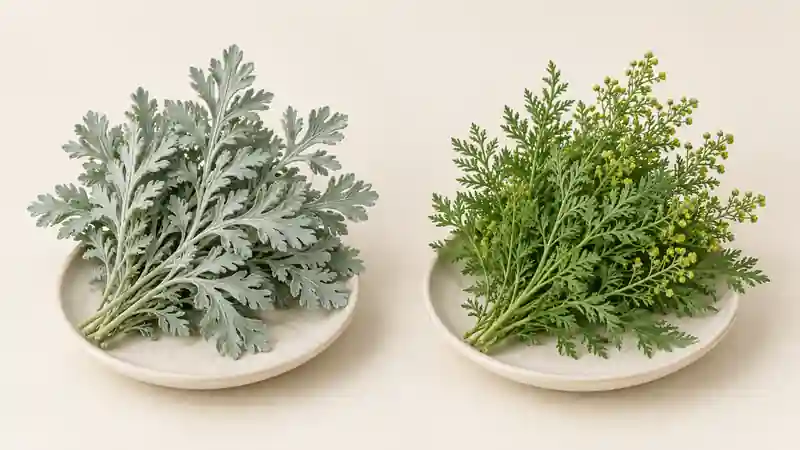

A wormwood vs sweet wormwood supplement comparison starts with the Latin name, not the large words on the front of the bottle. Wormwood usually means Artemisia absinthium, while sweet wormwood usually means Artemisia annua. They belong to the same genus but are different species with different chemical profiles. HerbEra uses a species-first editorial rule for Artemisia products because a common name alone cannot confirm what is inside a capsule, powder, or liquid extract.
This guide shows you how to verify the species, plant part, ingredient form, extract ratio, solvent, chemical markers, serving amount, and other ingredients. It also explains which conclusions you cannot draw from the word “wormwood.”
What is the main difference between wormwood and sweet wormwood?
Wormwood and sweet wormwood are separate botanical species. Artemisia absinthium is a perennial plant known for an intensely bitter profile and compounds such as absinthin. Its essential oil may contain thujone. Artemisia annua is an annual plant associated with artemisinin and a different mixture of terpenes, flavonoids, and volatile compounds.
The shared genus name does not make the plants interchangeable. Species identity affects the raw material, expected marker compounds, manufacturing controls, and relevant warnings.
| Label field | Wormwood | Sweet wormwood |
|---|---|---|
| Accepted botanical name | Artemisia absinthium L. | Artemisia annua L. |
| Common names | Wormwood, common wormwood, absinthium | Sweet wormwood, sweet Annie, annual wormwood, qing hao |
| Plant type | Perennial | Annual |
| Common supplement material | Leaves, leafy flowering tops, or aerial parts | Leaves or aerial parts |
| Notable chemical distinction | Absinthin and variable essential-oil compounds, including possible thujone | Artemisinin and related sesquiterpenes, with amounts that vary by raw material |
| Key label question | Does the panel state Artemisia absinthium and identify the plant part? | Does the panel state Artemisia annua and disclose whether artemisinin is measured? |
Why is the word wormwood not enough?
“Wormwood” can function as a specific common name for Artemisia absinthium, but sellers sometimes use it loosely for other members of the Artemisia genus. Terms such as sweet wormwood, annual wormwood, Roman wormwood, sea wormwood, and mugwort can refer to different species.
A front label may shorten the ingredient name for design reasons. The Supplement Facts panel should provide the more useful information. In the United States, a botanical ingredient must be identified by an accepted common or scientific name, and the plant part must be declared. Requirements differ across markets, so international shoppers should still look for the same core fields.
If a label says only “wormwood blend,” you cannot reliably determine the species, plant part, or chemical profile. Contact the manufacturer before using the product rather than guessing from the photograph or product title.
How do you identify the species on a Supplement Facts panel?
Find the complete ingredient line inside the Supplement Facts panel. The most informative format combines the common name, Latin binomial, and plant part.
Botanical name
Look for Artemisia absinthium when you want common wormwood. Look for Artemisia annua when you want sweet wormwood. The genus name alone, written as Artemisia spp., does not identify one species.
Plant part
The label may list leaf, flowering top, herb, or aerial parts. “Herb” often refers to above-ground material, but manufacturers should define the ingredient clearly. Leaves and flowering tops are not the same as roots, seeds, or essential oil.
Ingredient form
Check whether the amount refers to whole-herb powder, a liquid extract, a dry extract, or an isolated constituent. These forms can have very different concentrations. A milligram value has little meaning until you know what was weighed.
Other ingredients
Review the separate Other Ingredients list for water, glycerin, alcohol, capsule material, carriers, stabilizers, and preservatives. These substances may affect suitability, texture, taste, and the meaning of the finished serving.
What do common wormwood label phrases mean?
| Example wording | What it tells you | What it does not tell you |
|---|---|---|
| Wormwood herb 500 mg | The serving contains a stated weight of botanical material | The species, unless a botanical name appears nearby |
| Artemisia absinthium aerial parts powder | The species, plant portion, and whole-powder form | The amount of thujone or other individual compounds |
| Artemisia annua leaf extract 10:1 | The species, leaf source, and stated extract ratio | The artemisinin content unless separately measured |
| Sweet wormwood extract standardized to artemisinin | A selected marker is controlled to a declared level | Full chemical composition or overall product quality |
| Proprietary Artemisia blend | Multiple ingredients may be combined | The individual amount of each component |
| Wormwood tincture, one dropper | The suggested liquid serving | Concentration without a ratio, herb equivalent, or amount |
How should you read a wormwood tincture label?
Begin with the species and plant part. When reviewing an Artemisia absinthium liquid extract , confirm that the label names the leaf, flowering tops, or aerial parts rather than using “wormwood” by itself. Then inspect the extraction medium and concentration.
Many manufacturers use the word tincture for an alcohol-and-water extract. Others apply it to glycerin-based liquids. The Other Ingredients list should show whether the base contains alcohol, glycerin, water, or a combination.
A ratio such as 1:5 commonly means that one unit of starting botanical material was used to produce five units of finished extract under the manufacturer’s stated method. Ratios require context. Fresh and dried herbs have different water content, and weight-to-volume ratios cannot be compared blindly with weight-to-weight dry extract ratios.
HerbEra’s editorial stance is that a useful liquid label should make the species, plant part, serving volume, extraction medium, and botanical-equivalent amount easy to find. Front-label phrases should not replace these fields.
Does the milligram amount show which product is stronger?
No. Milligrams show the weight of the declared material, but the material may be whole plant powder, concentrated dry extract, or dried herb equivalent. These are not interchangeable measurements.
For example, 500 mg of whole-herb powder is not directly comparable with 100 mg of a 5:1 dry extract. The extract may have started with more raw botanical material, but the ratio alone does not show the concentration of every compound. The solvent determines which constituents move into the extract.
Use these questions when comparing amounts:
- Is the number for the raw herb or the finished extract?
- Does the label provide a drug-extract ratio or herb-to-extract ratio?
- Is a dried herb equivalent stated?
- What extraction solvent was used?
- Is the product standardized to a named marker?
- Does the amount apply per capsule, per milliliter, or per full serving?
A smaller milligram number does not automatically mean a weaker or more concentrated product. The preparation details must support that conclusion.
What should you know about thujone on wormwood labels?
Thujone is a naturally occurring monoterpene found in the essential oil of some Artemisia absinthium materials. Its amount can change with plant genetics, growing location, harvest stage, storage, plant part, and manufacturing method.
A standard herb powder, water infusion, hydroalcoholic extract, and concentrated essential oil should not be assumed to contain the same amount. Essential oil is a distinct and highly concentrated preparation. Do not use essential-oil directions for an herbal tincture or apply tincture directions to essential oil.
The European Medicines Agency monograph for covered Artemisia absinthium herbal products states that thujone content should be specified and daily exposure should remain below 6 mg. This is a product-specific regulatory reference, not a universal serving recommendation for every country or every supplement.
Labels that omit thujone data are not automatically unsafe, since content depends on the material and extraction process. However, the omission means you cannot calculate exposure from the label alone. Ask the manufacturer whether the finished product is tested for alpha-thujone and beta-thujone.
What should you know about artemisinin on sweet wormwood labels?
Artemisinin is a sesquiterpene lactone associated with Artemisia annua. It occurs mainly in the plant’s above-ground material, particularly leaves and inflorescences. Its concentration varies with cultivar, climate, harvest stage, drying, storage, and processing.
The words “sweet wormwood” do not guarantee a specific artemisinin amount. If a product is standardized, the panel should state the marker level or amount using clear units. If no standardization appears, do not estimate artemisinin content from the total milligrams of leaf powder.
An Artemisia annua tea, crude powder, general extract, isolated artemisinin ingredient, and standardized pharmaceutical preparation are different products. They do not have interchangeable composition, quality controls, dosing, or intended use. A supplement should not be used as a substitute for a prescribed pharmaceutical product.
Can you identify the plant by color, taste, or smell?
No. Sensory details may provide clues, but they cannot confirm species identity. Artemisia absinthium is notably bitter, yet bitterness varies with plant quality, amount, extraction, sweeteners, and flavoring. Several other plants in the genus also have bitter or aromatic profiles.
Powders from both species may appear green, gray-green, or brown after processing. Liquid extracts can range from pale amber to dark brown. Color also changes with solvent, concentration, oxidation, and storage.
Reliable identification requires supplier documentation and appropriate botanical testing. A product photograph, taste, or common name is not enough.
Checklist for Comparing Wormwood Supplements
Use this checklist on the front panel, Supplement Facts panel, and Other Ingredients list. If a key detail is missing, ask the manufacturer for clarification before using the product.
Confirm the Latin name
Look for Artemisia absinthium or Artemisia annua. Do not rely on the word “wormwood” alone.
Find the plant part
Check whether the ingredient comes from leaves, flowering tops, aerial parts, or another portion.
Identify the ingredient form
Determine whether the stated amount refers to powder, liquid extract, dry extract, or an isolated constituent.
Read the extract ratio
Look for a ratio and note whether it describes fresh herb, dried herb, liquid extract, or dry extract.
Check the extraction medium
Review the label for water, alcohol, glycerin, or another solvent.
Look for measured markers
Check whether thujone or artemisinin is tested and whether an actual amount or percentage is disclosed.
Calculate the full serving
Multiply the amount per unit by the number of capsules, drops, or milliliters in the suggested serving.
Review warnings and testing
Look for age restrictions, pregnancy warnings, medication cautions, allergen details, and independent quality testing.
Who should use extra caution with Artemisia supplements?
People who are pregnant or breastfeeding should avoid making assumptions about suitability because safety information is incomplete and concentrated products may differ substantially. Artemisia plants belong to the Asteraceae family, so people sensitive to ragweed, daisies, chrysanthemums, or related plants may have a greater allergy risk.
Children, people with seizure disorders, and anyone taking prescription medication should seek professional guidance before using concentrated wormwood products. Stop using a supplement and request medical advice if an unexpected reaction occurs.
Do not ingest an essential oil simply because an herb with the same common name appears in dietary supplements. Essential oils have a different concentration and safety profile.
FAQ
Are wormwood and sweet wormwood the same plant?
No. Wormwood is usually Artemisia absinthium, while sweet wormwood is Artemisia annua.
What Latin name should appear on a wormwood supplement?
Common wormwood should list Artemisia absinthium. Sweet wormwood should list Artemisia annua.
Does every sweet wormwood supplement contain the same amount of artemisinin?
No. Artemisinin content varies with the plant material and processing. Look for a measured amount or standardized percentage.
Does every wormwood product contain thujone?
Not at the same level. Thujone content varies by plant material, chemotype, plant part, and extraction method.
Is a tincture the same as an essential oil?
No. A tincture is a liquid botanical extract. Essential oil is a concentrated volatile fraction with a different composition.
Can I compare wormwood products by milligrams alone?
No. First determine whether the milligrams refer to powder, finished extract, or dried herb equivalent.
What does a 10:1 wormwood extract mean?
It generally indicates that ten units of starting botanical material produced one unit of extract. It does not state the amount of every compound.
What should I do if the label lists only Artemisia?
Ask the manufacturer for the complete species name, plant part, and ingredient specifications before using the product.
Glossary
Aerial parts
The portions of a plant above the ground, usually including stems, leaves, and flowers.
Artemisinin
A sesquiterpene lactone associated with Artemisia annua.
Botanical name
The standardized Latin genus and species used to identify a plant.
Chemotype
A chemically distinct form within a plant species.
Dried herb equivalent
The stated amount of dried botanical material represented by a serving of extract.
Extract ratio
A ratio comparing the starting botanical material with the resulting extract.
Standardized extract
An extract adjusted or tested to contain a stated level of a selected marker.
Thujone
A volatile plant compound that may occur in the essential oil of common wormwood.
Tincture
A liquid botanical preparation commonly made with alcohol and water, although some products use glycerin.
Conclusion
A wormwood vs sweet wormwood supplement decision should begin with the botanical name: Artemisia absinthium and Artemisia annua are different species. Verify the plant part, preparation, solvent, extract ratio, serving amount, marker data, and warnings before comparing products.
Sources Used
Accepted botanical identity for common wormwood – powo.science.kew.org, Artemisia absinthium
Accepted botanical identity for sweet wormwood – powo.science.kew.org, Artemisia annua
Wormwood herb identity, preparation, and thujone guidance – ema.europa.eu, Absinthii Herba
Scientific assessment of Artemisia absinthium herb – ema.europa.eu, Wormwood Assessment Report
Sweet wormwood raw materials and phytochemistry – pubmed.ncbi.nlm.nih.gov, Artemisia annua Current State of Knowledge
Artemisinin location and plant chemistry – pubmed.ncbi.nlm.nih.gov, Artemisia annua Review
Botanical supplement forms and extract ratios – ods.od.nih.gov, Botanical Dietary Supplements
Required botanical and plant-part labeling fields – fda.gov, Dietary Supplement Labeling Guide
Dietary supplement ingredient and serving declarations – fda.gov, Questions and Answers on Dietary Supplements
Variation in non-pharmaceutical Artemisia preparations – who.int, Artemisia Technical Review